 English
 Русский
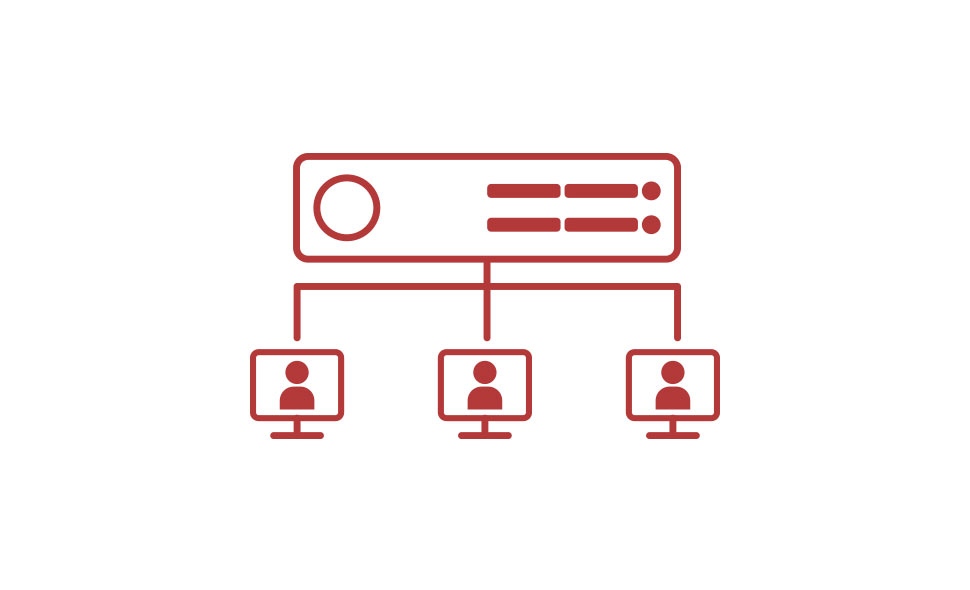
VDI (Virtual Desktop Infrastructure) is a technology designed to provide users with remote access to virtual desktops that run on a centralized server or in a data center. With VDI, users can work with applications, software, and data as if everything were running on their local computer, while the actual computing environment is hosted centrally.
VDI began to develop in the early 2000s alongside the rise of server virtualization. Companies such as VMware and Citrix became pioneers in this area by offering solutions for desktop virtualization. One of the first commercial VDI solutions was introduced by VMware in 2006 under the name VMware Virtual Desktop Infrastructure, which later evolved into what is now known as VMware Horizon.
Advantages of VDI
-
Centralized management.
Administrators can manage all virtual desktops from a single location, simplifying updates, maintenance, and technical support. -
Improved security.
Data is stored on central servers rather than on local devices, significantly reducing the risk of data loss or leakage. -
Fast scalability.
New desktops and users can be added quickly without the need to purchase additional physical computers.
User convenience. Users can access their desktops from virtually any device and from any location with an internet connection.
Disadvantages of VDI
-
Cost.
Initial investments in infrastructure, licenses, and server hardware can be significant, especially for small businesses. -
Complexity.
Deployment and administration of VDI require specialized knowledge and experience. -
Network dependency.
Stable and high-speed network connectivity is essential for comfortable day-to-day work.
Differences Between VDI and RDP
VDI is not a direct equivalent of RDP, although both are used for remote desktop access. RDP is a protocol developed by Microsoft that allows users to connect to and control a remote computer or server session. VDI, by contrast, is a comprehensive infrastructure solution that delivers fully virtualized desktops through centralized management platforms.
VDI typically provides a higher level of security because all data and applications remain on central servers rather than on users’ local devices. It also makes it easier for administrators to create, manage, update, and scale desktop environments as needed. This significantly simplifies IT infrastructure management in large organizations.
According to various industry studies, by 2024 more than 70% of large enterprises were expected to use VDI or similar technologies to provide remote access to work environments. The growing popularity of VDI is driven by the expansion of remote work and increasing demands for data security.