 English
 Русский
NVMe (Non-Volatile Memory Express) is a high-performance interface and communication protocol designed specifically for solid-state drives (SSDs). It enables much faster and more efficient access to non-volatile memory than older storage interfaces and is widely used in servers, data centers, and high-performance workstations. NVMe has also become common in consumer PCs and laptops as fast storage has gone mainstream.
Unlike older protocols such as SATA or SAS, which were originally designed for hard drives, NVMe was built from the ground up for flash memory. It communicates directly over the PCI Express (PCIe) bus, allowing SSDs to operate at their full potential.
The NVMe standard is developed and maintained by the NVM Express organization, a consortium of leading technology companies including Intel, Samsung, and many others. The first NVMe specification (version 1.0) was released in 2011, and large-scale adoption began in the mid-2010s as PCIe-based SSDs became widely available.
Advantages of NVMe
-
The most important benefit of NVMe is its very high speed. Because it uses PCIe instead of SATA, NVMe SSDs offer far higher bandwidth. Modern NVMe drives can reach several gigabytes per second in sequential read and write performance, far exceeding traditional SATA SSDs.
-
NVMe also delivers much lower latency. Its streamlined command set and direct connection to the PCIe bus significantly reduce input/output delays, which is critical for databases, virtualization, and other performance-sensitive workloads.
-
Another key advantage is parallelism. NVMe supports thousands of command queues with many thousands of commands per queue, allowing modern multi-core CPUs to access storage in parallel and much more efficiently.
Disadvantages of NVMe
-
Cost is still a factor. NVMe drives are typically more expensive than SATA SSDs with similar capacity, especially in enterprise-grade models.
-
Compatibility can also be an issue. Older systems may not support NVMe without firmware updates or additional hardware, which can require upgrades to the motherboard or BIOS.
-
NVMe drives also generate more heat due to their high performance. In compact systems or servers with many drives, this often requires better cooling or dedicated heatsinks to avoid thermal throttling.
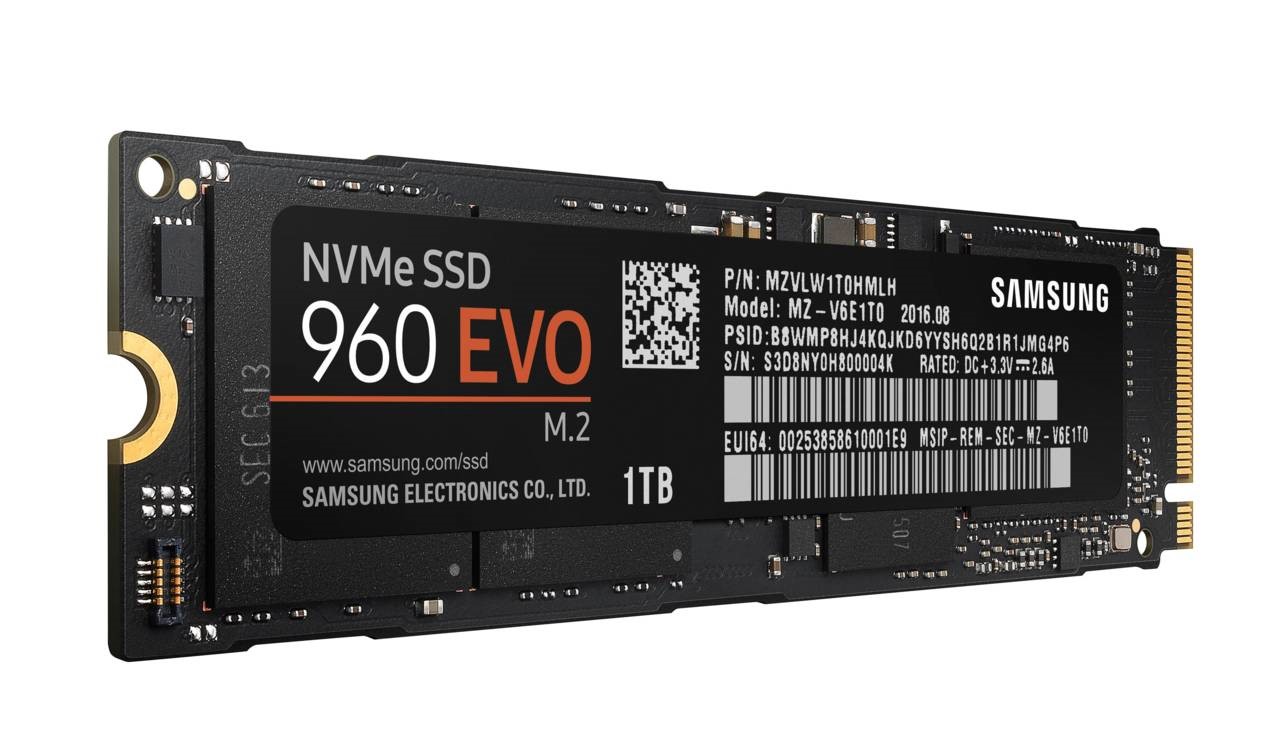
Samsung NVMe SSD Drive
NVMe has become the standard storage interface for modern high-performance systems. It is now the dominant choice in new servers and increasingly in consumer devices, driven by the need for faster, more responsive storage.